
Home » Posts tagged 'education' (Page 3)
Tag Archives: education
Knewton’s Knitch: Thoughts to Ponder
On the Today Show, a segment was dedicated to, “The Classroom of the Future.” [see TV segment below] The initial comments pointed out that the “present educational system is impersonal, a factory model.” This is followed by a set of statistics with no sources to verify. Then the background voice of Jose Ferreira, founder and CEO of Knewton, makes this comment, “How many da Vinci’s, Einsteins, and Marie Curie’s, and Michael Jordon’s are we losing every generation because we are not giving them the opportunities that some of us have?” What? How did Michael Jordon fall in the same category of the great scientists? Okay, move on, the broadcast continues, in order to solve this problem of inequity and problems in the status quo, the solution becomes a what if question. What if everyone had access to the Internet?
Lest we forget, Jose Ferreira runs a business. A subtle note focuses that this is a company (.com) versus an educational research group (.org). On his webpage (www.knewton.com) you are faced with a large screen counting the number of sales pitches he is making in the global market. When I viewed the page the count was 270, 952,575 and counting. This is not the number of students that are using his software, not the number of students learning from his program, and not the number of students graduating because of his program, but the number that are being ‘invited.’
In the broadcast, Mr. Ferreira says, “the present system is impersonal, a factory model.” And, what exactly is a software program? It is impersonal and a factory made model. Now, at this point, I should state that I am not against technology. I hold two B.S.I.T. degrees and worked in a secondary technology school for 22 years. I also was the first teacher, documented in 1996, to launch the first global educational program on the Internet. My program, Space Island’s, reached 2.3 million teachers and students in forty nations, and was placed into the Library of Congress as a historical event in 1996.
The Knewton Webpage is full of pictures of adults working one-to-one with young people, however, the software program is designed to work one-to-one with the student. It is a template of problems and clocked timings to match the student’s ability. Where is the challenge for student growth by matching those variables? But that is what his knerds, yes that is what they call themselves, I believe this must be the generation that ate Knudsen products. Anyway, the knerds design standardized templates! Now, where have I heard that term before? I believe that knerds are well educated and excellent programmers and data collectors, but lest we forget where these individuals got their education. It wasn’t from the Knewton factory but from the public or private schools these engineers graduated from.
If you go to the careers tab of Knewton Website you’d think you would find examples of students who have used the Knewton program and what careers (engineers, teachers, scientists, and programmers) they have landed in. No, you find out how lavish the knerd employees are being treated with their own private areas, food services, and perks. This is the selling page for those interested in employment to Knewton! Now, where do you suppose the money comes from to cater to these benefits? There is much hype that this software and program is a pantology that will create a panacea for the present educational system. However, in reality, it is nothing but a set of organized, timed, impersonal-factory templates.
The broadcast also details the work of Khan Academy and its founder, Sal Khan, whose Youtube math tutorials are quite good and free. Mr. Khan’s approach is to tutor in short segments with a lively and entertaining presentation. Adding the good works of Sal Khan’s Academy model to Knewton is comparing apples to oranges.
Knewton is not free, but its founder at the beginning of the broadcast states, “…we (the status quo, which he has now joined) are not giving them (students) the opportunities that some of us have.” Yes, Mr. Ferreira, what opportunities did you have? How is your program giving students in the global arena those same opportunities? The only opportunity I see is Knewton found a nitch to sell its product like Apple Computers did. It will be interesting to see how many Michael Jordon’s make it to the big league by playing a video game instead of one-on-one on the court!
The Real Reason for Brains
Daniel Wolpert: The real reason for brains
Boys Do Learn Better in Single-Sex Classes
 Interesting enough we already do separate boys and girls. In sports, club activities (the Boy Scouts and Girl Scouts), some organizations (YMCA and YWCA), even some summer camps are restricted to same sex activities, bathrooms and changing rooms. There are others.
So, if we accept these separations why not at the educational level? Brain and physiology studies show that boys and girls develop at different rates at different times. Why do we continue to insist and expect that putting both sexes in the same classroom and teaching both sexes exactly the same will work?
Alabama has separated the sexes and now has come under attack by the ACLU.
“We understand that teachers and parents want to provide the best education for their children. But coeducation was never the problem with failing schools, and single-sex programs are not the answer,” said Christina Brandt-Young, attorney with the ACLU Women’s Rights Project. “These programs are poorly designed and based on pseudoscience and stereotypes that do nothing to enhance learning, and only reinforce discredited ideas about how boys and girls behave” (Leech, 2012).
Single-sex education has been around for thousands of years. It wasn’t until the end of the 18th Century that co-educational classes were being instituted in the United States. In 2005 covering 2221 studies was commissioned by the US Department of Education entitled Single-sex versus coeducational schooling: A systematic review. The review demonstrated positive results and arguments for establishing public single sex classes.
True, every child learns differently. Researcher and educator, Howard Gardner (Harvard University), developed a study and discovered seven distinct intelligences called Gardner’s Multiple Intelligence. These seven distinct intelligences also work differently with how boys and girls perceive their world. The ACLU lawyers have no foundation for their political case. In the last 10 years, there has been a multitude of brain and cognitive research to demonstrate how male and female brains form, perceive their environments and function. The good point that we can all be thankful for are that these are lawyers not educators.
While the fight continues in Alabama, a successful experiment of separating 5th grade boys and girls has shown much success in the Bronx in New York.

The single-sex classes at Public School 140, which started as an experiment last year to address sagging test scores and behavioral problems, are among at least 445 such classrooms nationwide, according to the National Association for Single-Sex Public Education. Most have sprouted since a 2004 federal regulatory change that gave public schools freedom to separate girls and boys (Medina, 2009).
After working in two all boys private high schools here in Southern California for the past 25 years, I am confident that boys learn better in a single-sex environment. The statistics of the number of boys graduating from single-sex schools, and the percentage of college acceptance letters these boys have received is higher than boys from local area public high schools. These statistics are on record. I would be open to questions and further discussion on this topic.
Reference:
Leech, M. (2012). Alabama public school separates boys and girls for all classes. The ACLU has a problem with this. Retrieved from http://www.cafemom.com/group/99198/forums/read/17736762/Alabama_public_school_separates_boys_and_girls_for_all_classes_The_ACLU_has_a_problem_with_this
Medina, J. (2009, March 10). Boys and Girls Together, Taught Separately in Public School. New York Times. Retrieved from http://www.nytimes.com/2009/03/11/education/11gender.html?pagewanted=all&_r=0
National Association for Single Sex Education. http://www.singlesexschools.org/home.php
No Whitewash Here
 If you are male, The Adventures of Tom Sawyer is not just a classic piece of literature, but an educational manual on how boys function and learn. On the other hand, if you are female your perception might be closer to how a boy learned what true love and forgiveness was. It is true; men and women are wired differently.
I would argue that boys who lived in the 19th Century are not that far removed from boys living in the 21st Century. True, city boys today don’t have small islands to go off to play pirates, but they still play pirates today using Lego’s or by becoming a character in a video game.
Hidden in The Adventures of Tom Sawyer are life’s lessons that boys grow to learn as well as how they best learn them. So, allow me to take a few excerpts from this manual that might help you with your son or male student in better understanding how a boy thinks and how to motivate him.
Boys enjoy motivating themselves by scoring the highest points, being the first to reach the next level in a video game, or achieving a Letter in a sport activity. So, why doesn’t this happen in the classroom with grades as the point maker, or being able to move on to the next chapter of a book, or achieving a certificate, ribbon or button? Let’s see what Mr. Twain has to say about this.
“Work consists of whatever a body is obliged to do, and that Play consists of whatever a body is not obliged to do… There are wealthy gentlemen in England who drive four-horse passenger-coaches twenty or thirty miles on a daily line, in the summer, because the privilege costs them considerable money; but if they were offered wages for the service, that would turn it into work and then they would resign.”
Boys will spend a considerable amount of time learning the ins and outs of a video game, working long hours to find a noise in a car engine, or reading cheat notes for a game in play. However, getting a boy to do his homework, turn in his homework on time, or even using the spell checker when typing up a paper involves threats, punishments and sanctions from both parents and teachers. So, how does one motivate a boy? Again, Twain supplies another hint.
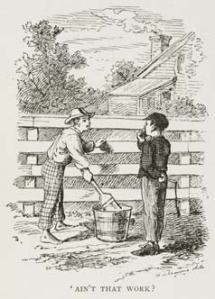
Whitewash
Tom wheeled suddenly and said:
“Why, it’s you, Ben! I warn’t noticing.”
“Say – I’m going in a-swimming, I am. Don’t you wish you could? But of course you’d druther work – wouldn’t you? Course you would!”
Tom contemplated the boy a bit, and said:
“What do you call work?”
“Why, ain’t that work?”
Tom resumed his whitewashing, and answered carelessly:
“Well, maybe it is, and maybe it ain’t. All I know, is, it suits Tom Sawyer.”
“Oh come, now, you don’t mean to let on that you like it?”
The brush continued to move.
“Like it? Well, I don’t see why I oughtn’t to like it. Does a boy get a chance to whitewash a fence every day?”
That put the thing in a new light. Ben stopped nibbling his apple. Tom swept his brush daintily back and forth – stepped back to note the effect – added a touch here and there – criticized the effect again – Ben watching every move and getting more and more interested, more and more absorbed. Presently he said:
“Say, Tom, let me whitewash a little.”
“Tom said to himself that it was not such a hollow world, after all. He had discovered a great law of human action, without knowing it — namely, that in order to make a man or a boy covet a thing, it is only necessary to make the thing difficult to attain.”
There are ways to motivate boys, but are not what you either might expect or consider. “Though this be madness, yet there is method in ‘t.”, (Shakespeare, Hamlet, Act II Scene 3). First, there are dominance hierarchies for both sexes, but the boys’ hierarchy tends to be more stable (that is, the rules are more agreed upon) than the girls hierarchy (Maccoby, E.E., & Jacklin, C. N., 1999), and women need to understand this in order to motivate boys. A boy is born already hardwired in this. Secondly, boys must have a vested interest in order to work. Understanding these and other rules that govern a boy’s actions help teachers in planning their classroom lessons. Twain’s whitewash scenario addresses all of these points, however with that said, it should also be understood that these rules need to be tweaked depending on the boy’s culture, socioeconomic level, and age. One size doesn’t fit all here.
So, are we back to square one? No. There are common denominators that fit all boys that can be discussed and implemented. I have found, in my 30 years of education, the old adage, “Boys will be boys,” to be quite true whether I was dealing with a boy from a Yaqui reservation, or a boy from the Bronx; a boy from Japan or from Holland. I have researched, implemented and tweaked several fields of educational research that worked with boys of different socioeconomic standings, different cultures, and ages. I have discovered gems and exposed media hype in topics of brain research to educational marketing tools. The purpose of this blog is to create and serve the global educational community with what is being done to address the theories, programs and projects that are getting results with how boys best learn. I am looking forward to the dialogs and exchanges that will help boys, at all ages, to achieve their potentials in education and their futures.
References
Maccoby, E.E., & Jacklin, C. N. (1999). The Psychology of Sex Differences. Stanford, CA: Stanford University Press.
Twain, M. (1876). The Adventures of Tom Sawyer. Retrieved from http://www.cs.cmu.edu/~rgs/sawyr-table.html.
 Leonardo's Apprentice